
Sheela-na-Gig
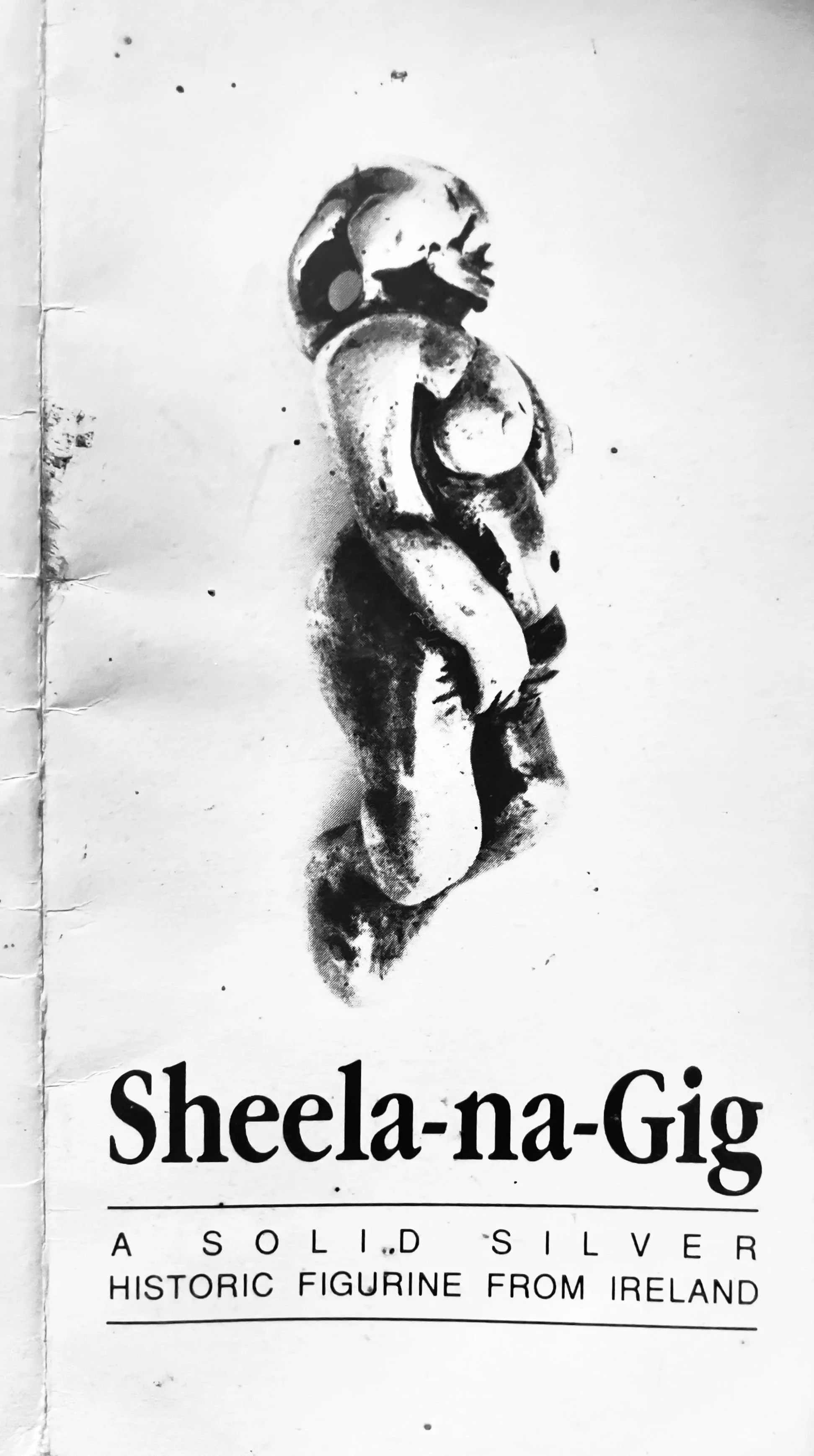
A solid silver figurine from Ireland, made by Pat Connor
PJC
THE HALLMARK
Since 1637 the COMPANY OF GOLDSMITHS OF DUBLIN has been the recognised authority empowered to verify that objects of gold, silver and platinum correspond to legally accepted standards of purity. The Hallmark which is stamped on the body of the Sheela-na-Gig figurine is Patrick Connor's own personal mark, registered at the Assay Office in Dublin Castle and exclusive to work produced by him. The Harp Crowned represents sterling silver assayed in Dublin; the PJC initials represent the artist's name and the capital letter the year of manufacture.
Since 1637 the alphabet in different styles has been run through fourteen times, enabling precious metals experts to date precisely to the year anything made over a period of three and a half centuries which bears a Hallmark. The current series began with A in 1986.
Occasionally an individual year will have an extra symbol, usually to commemorate a specific event of national significance.
PJC PATRICK CONNOR
HALLMARKED GOLD & SILVER
PAT CONNOR DESIGN STUDIO, SCHULL, WEST CORK, IRELAND P81 P992
The Sheela-na-Gig in Irish Folk Tradition
Although Ireland is now one of the least densely populated countries in Europe you cannot go very far whether in city, town or open countryside without encountering a ruin or historic monument of some kind, relics of the tribes and peoples, lords and abbots, common people and mythical gods who occupied the land in bygone eras. The magnificent burial mounds at Newgrange in the valley of the river Boyne and which predate the Egyptian Pyramids, are encrusted with an elaborate sequence of sculpted slabs which chart the movements of the stars. From Newgrange over a passage of five thousand years the peoples who inhabited the island of Ireland contributed, in each generation, to the moulding of the landscape with different forms of monuments as tribe after tribe, people after people waged war and struggled for supremacy and territory. The evidence for the passing of so many periods of history is in what remained after time had moved on and only the stones were left to tell the story.
If the Neolithic age of Newgrange was a cultural strong point, then so also was the Early Christian period dating from the fifth century AD, when according to tradition St. Patrick introduced Christian beliefs into a previously pagan country. Ireland was unique in Western Europe in remaining outside the Roman Empire which had overrun Europe and instead of Christianity having to compete with Roman deities as in neighbouring Britain, the native Celtic beliefs were still strong when the first Christians arrived in Ireland. These Early Christians seem to have adopted a fairly pragmatic approach to the indigenous beliefs. Some they opposed, many they adapted into Christian practice by merely calling them by different names. A few centuries later Christianity had become the national faith yet it carried with it all sorts of superstitions and fetishes which were a survival of earlier times. The Sheela-na-Gig is an example of beliefs from pagan Ireland which still maintain some potency at the end of the twentieth century.
Situated in a remote valley in County Cork is the shrine of St. Gobnait, the patron saint of beekeepers. What greets the visitor today is a succession of ruins, indicating the antiquity of the association between this spot and the tradition of the saint. There are some circular Early Christian monk's cells, a group of inscribed stones and a later chapel dating perhaps from the fourteenth century.
People come here annually on the Saint's Day, 11th February, to visit the shrine and to pray at a sacred well. They have been doing so for at least fifteen hundred years, perhaps longer. One of the parts of the "round" to be visited is an object set into the stonework of the medieval chapel. This is an erotic female effigy, squat in shape with the hands gripping the thighs and the legs apart in an attitude of display. It is crudely carved and placed on the exterior of the chapel where it could be seen at all times although it obviously predates the building and was evidently placed there to facilitate public access. It is a Sheela-na-Gig, a primitive fertility and good luck talisman and survivor of one of the oldest cults known to human society. It's position on the outside of St. Gobnait's chapel is characteristic of where ‘Sheelas’ are to be found all over Ireland, set into the outsides of later buildings, maintaining a link between the beliefs of the remotest antiquity and the present day.
Among all the relics of antiquity in Ireland nothing remains as enigmatic as the Sheela-na-Gig figures. Who made them, for precisely what purpose and when were they carved? Scholars have come up with no precise answer to these questions which remain enveloped in mystery. Even their meaning remains part of the enigma although their erotic content can hardly be in doubt. The name in Irish is generally interpreted as "Sheela of the breasts" or "Squatting Sheela" either of which describe the appearance of most of the figures. As well as the obvious cult of fertility associated with the Sheela-na-Gig is the concept of warding off the evil eye.
Traditional societies all over the world believe in the power of an individual to
"put the evil eye on them" and in rural Ireland this was a commonplace belief up to very recent times. If a farmer's cattle refused to give milk or if some animal unaccountably died it was automatically assumed that black magic was at work. It was believed that a Sheela-na-Gig could give protection against such evil intentions.
The touching of the Sheela at St. Gobnait's shrine has as much the association of warding off evil as it has in sexuality and procreation. A correspondent to the Irish Times writing in 1977 relates an incident which he observed during the nineteen hundreds when the matriarch of some clan in Co. Galway who had long been in dispute with their neighbours defended her cottage against a band of armed men by hitching up her clothes and displaying her naked genitals! "The enemies of her and her family fled in terror". Such is the power of the Sheela-na-Gig.
Of the approximately one hundred examples of Sheela-na-Gigs so far identified in Ireland, no two are identical either in appearance or workmanship. The single element which all have in common is the legs apart, genitals displayed position. Some have large breasts, others none at all. Most have a rather rudimentary face yet a few are actually smiling.
Almost all are carved in a rough manner. Whatever their appearance, date and meaning, it is clear that they have powers both of allure and rejection and the varying emphasis which different examples express may relate to the separate traditions which have been passed down from antiquity, that of a primitive Venus, a symbol of fruitfulness and also one of power.
Essay by Brian Lalo
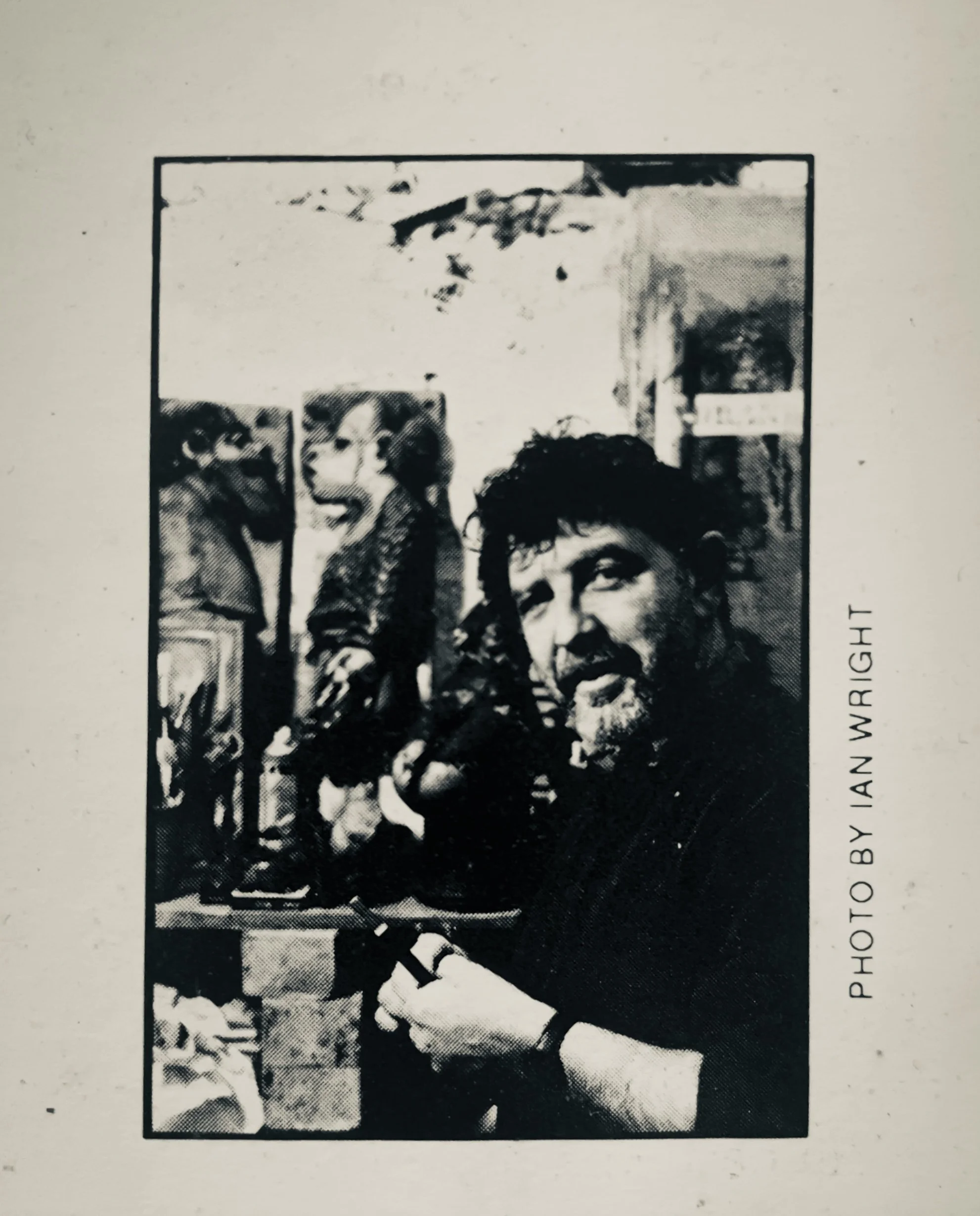
PAT CONNOR was born in Dublin and studied fine art at the National College of Art and Design, the leading art academy in Ireland. Subsequently he established his studio in the beautiful and rocky landscape of West Cork at the extreme south west of the island under the protective shadow of Mount Gabriel. Here in an idyllic location, surrounded by wild vegetation and overlooking a waterfall, his sculptures began to inhabit the landscape as work emerged from the studio to people the surrounding area. It was initially from his work in ceramics that his reputation was established as a fine craftsman as
well as a witty observer of the human scene. Working in porcelain as well as stoneware he created a gallery of human types from the miniature to lifesize which portrayed groups and individuals with an acute sense of observation.
As an exhibitor Pat Connor has shown extensively in Ireland and also in Europe, Great Britain and the United States. Through the wide range of his creative output runs a theme of love of life and a deep satisfaction in the humour of the human condition. His Sheela-na-Gig unites the Ireland of the remote past with the immediate present and shows that whatever changes may occur in Ireland and the wider world that human sensuality is a timeless and universal language. Long may it remain SO.
Pat Connor will continue to explore themes from both the Celtic and International pást and to create new images based on a re-interpretation of old traditions; in keeping with the miniature treatment of the Sheela-na-Gig, further images from his studio will be usable both as personal jewellery, dress ornaments and objects of fine-art in their own right and as such eminently collectible.