
Cara
TOWARDS A PARTICULAR IRISHNESS
Pat the Potter
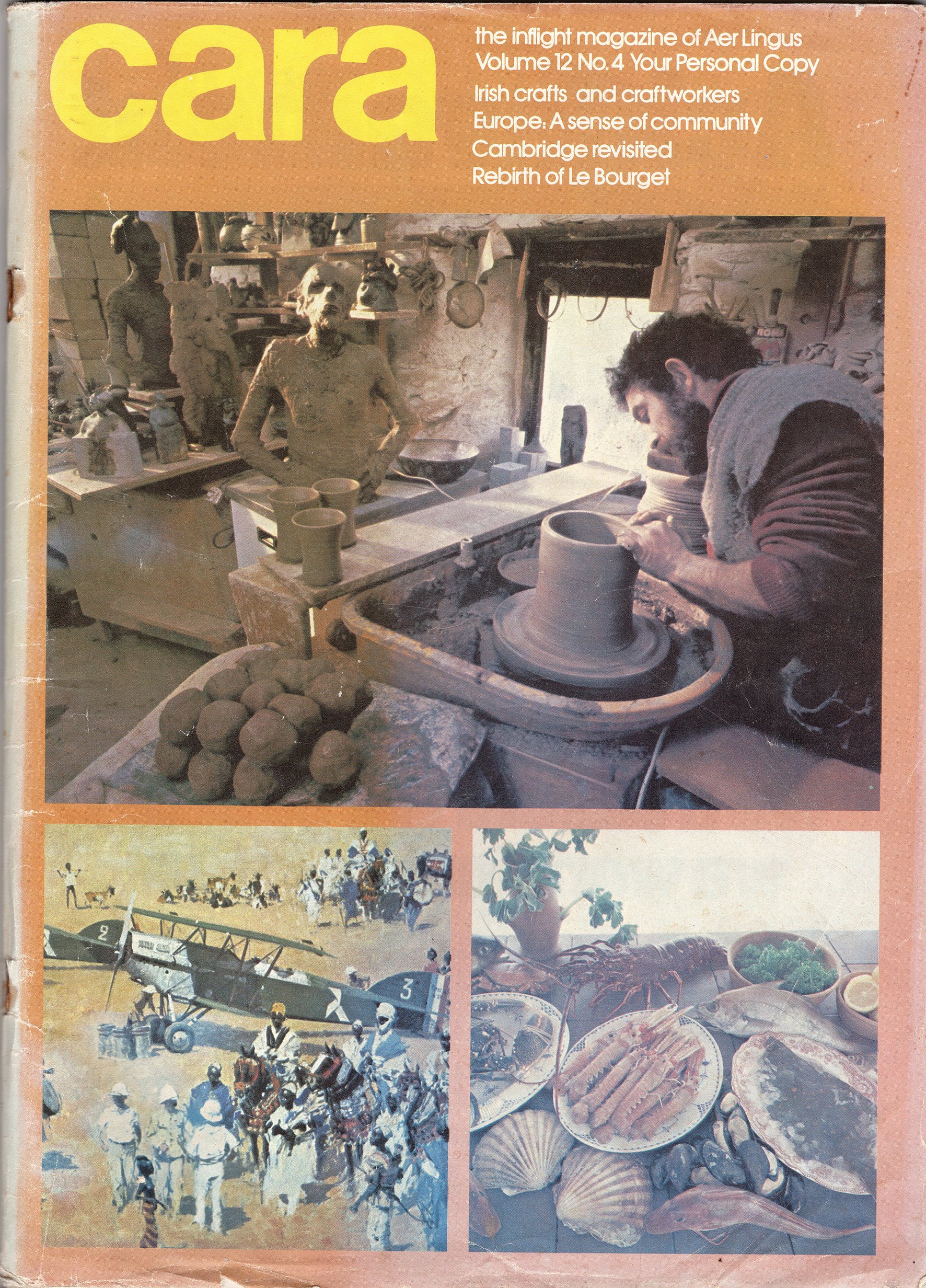
Aer Lingus inflight magazine 1978
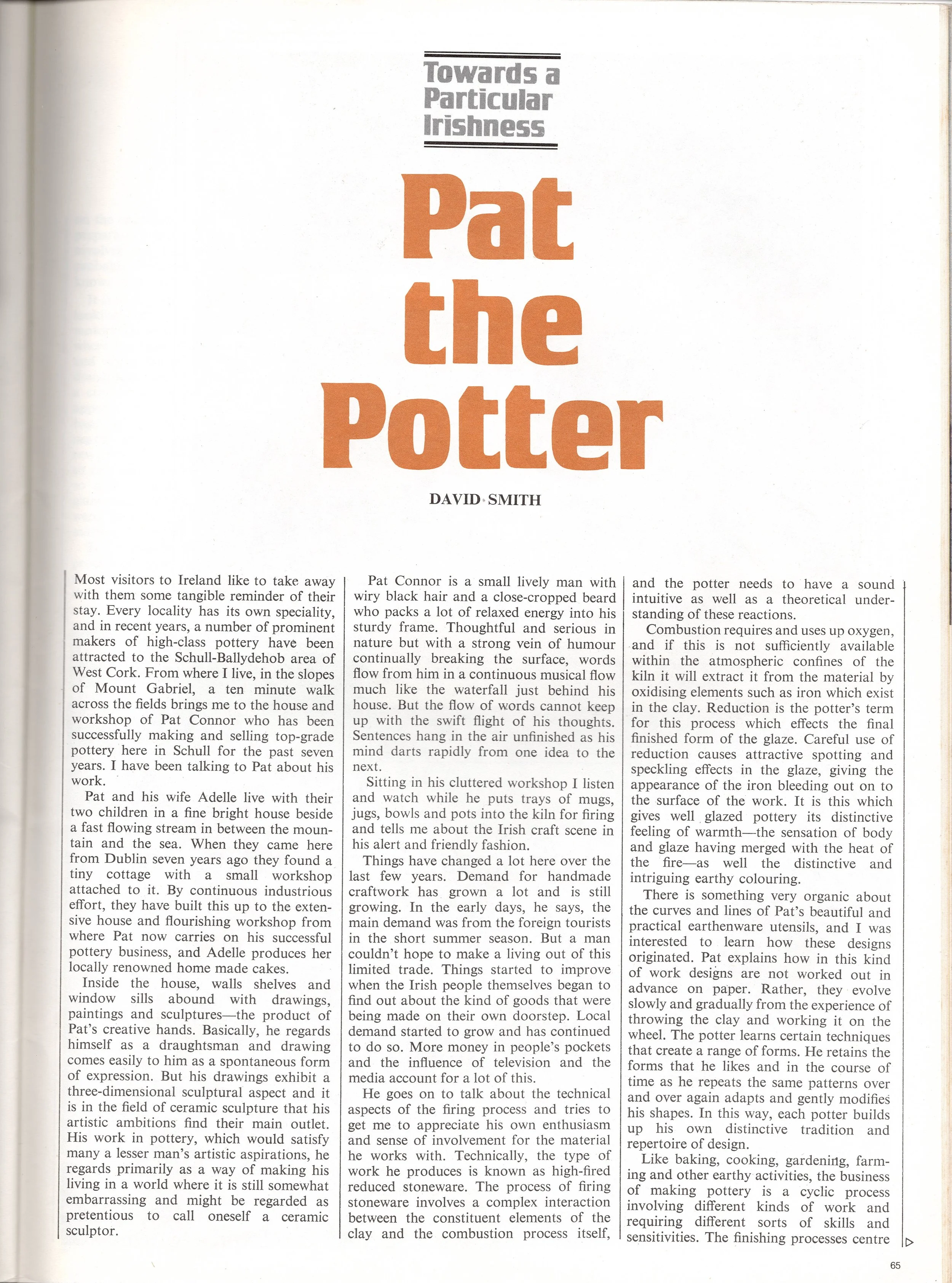
By DAVID SMITH
Most visitors to Ireland like to take away with them some tangible reminder of their stay. Every locality has its own speciality, and in recent years, a number of prominent makers of high-class pottery have been attracted to the Schull-Ballydehob area of West Cork. From where I live, in the slopes of Mount Gabriel, a ten minute walk across the fields brings me to the house and workshop of Pat Connor who has been successfully making and selling top-grade pottery here in Schull for the past seven years. I have been talking to Pat about his work.
Pat and his wife Adèle live with their two children in a fine bright house beside a fast flowing stream in between the mountain and the sea. When they came here from Dublin seven years ago they found a tiny cottage a small workshop attached to it. By continuous industrious effort, they have built this up to the extensive house and flourishing workshop from where Pat now carries pottery business, and Adèle produces her locally renowned home made cakes.
Inside the house, walls and shelves and window sills abound with drawings, paintings and sculptures-the product of Pat's creative hands. Basically, he regards himself as a draughtsman and drawing comes easily to him as a spontaneous form of expression. But his drawings exhibit a three-dimensional sculptural aspect and it is in the field of ceramic sculpture that his artistic ambitions find their main outlet. His work in pottery, which would satisfy many a lesser man's artistic aspirations, he regards primarily as a way of making his living in a world where it is still somewhat embarrassing and might be regarded as to call oneself a ceramic sculptor.
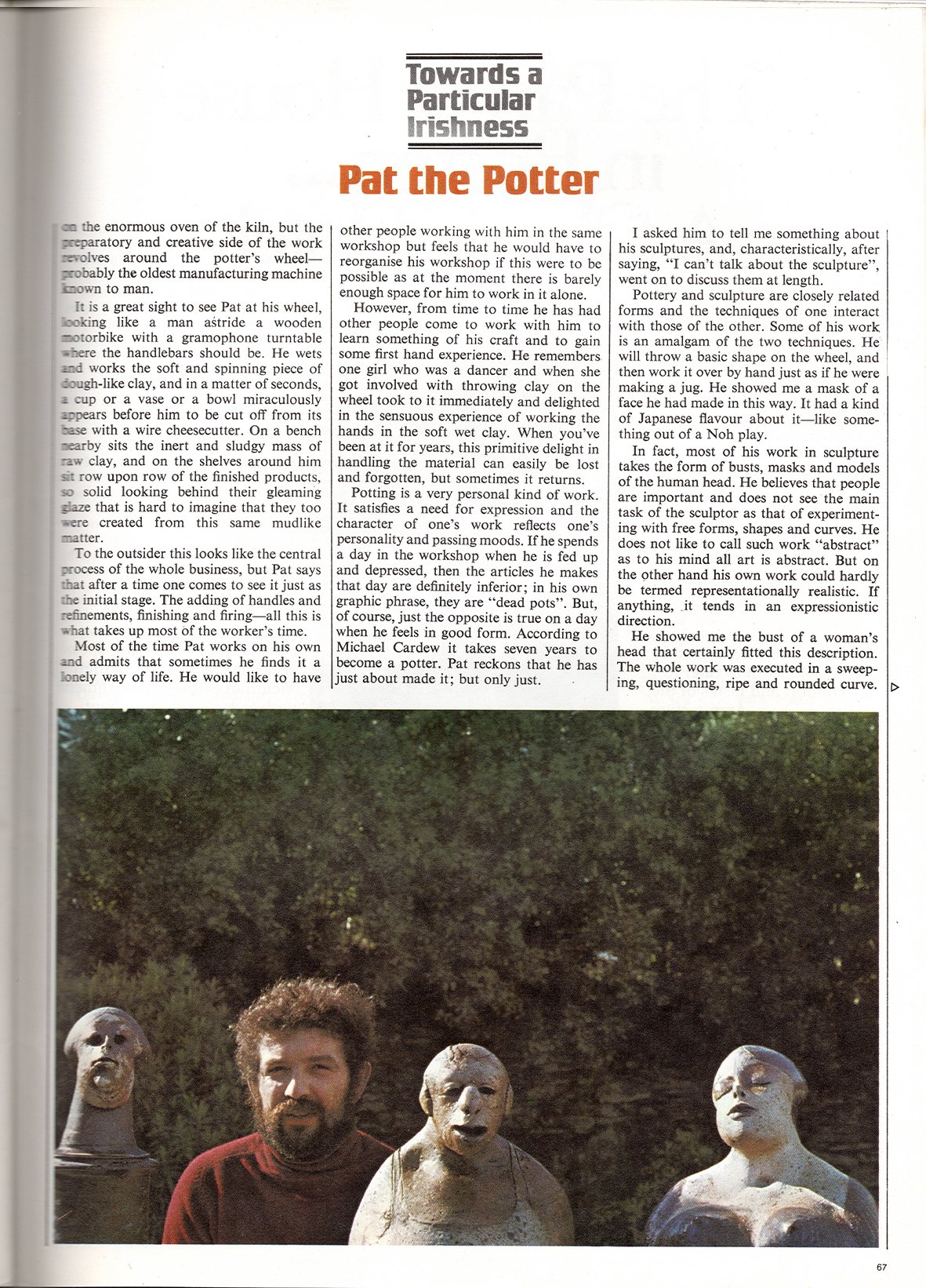
Pat Connor is a small lively man with wiry black hair and a close-cropped beard who packs a lot of relaxed energy into his sturdy frame.
Thoughtful and serious in nature but with a strong vein of humour continually breaking the surface, words flow from him in a continuous musical flow much like the waterfall just behind his house. But the flow of words cannot keep up with the swift flight of his thoughts. Sentences hang in the air unfinished as his mind darts rapidly from one idea to the next.
Sitting in his cluttered workshop I listen and watch while he puts trays of mugs, jugs, bowls and pots into the kiln for firing and tells me about the Irish craft scene in his alert and friendly fashion.
Things have changed a lot here over the years. Demand for handmade craftwork has grown a lot and is still growing. In the early days, he says, main demand was from the foreign tourists in the short summer season. But a man couldn't hope to make a living out of this limited trade. Things started to improve when the Irish people themselves began to find out about the kind of goods that were being made on their own doorstep. Local demand started to grow and has continued to do so. More money in people's pockets and the influence of television and the media account for a lot of this.
He goes on to talk about the technical aspects of the firing process and tries to get me to appreciate his own enthusiasm and sense of involvement for the material he works with. Technically, the type of work he produces is known as high-fired reduced stoneware. The process of firing stoneware involves a complex interaction between the constituent elements of the clay and the combustion process itself, and the potter needs to have a sound intuitive as well as a theoretical understanding of these reactions.
Combustion requires and uses up oxygen, and if this is not sufficiently available within the atmospheric confines of the kiln it will extract it from the material by oxidising elements such as iron which exist in the clay. Reduction is the potter's term for this process which effects the final finished form of the glaze. Careful use of reduction causes attractive spotting and speckling effects in the glaze, giving the appearance of the iron bleeding out on to the surface of the work. It is this which gives well glazed pottery its distinctive feeling of warmth - the sensation of body and glaze having merged with the heat of the fire - as well the distinctive and intriguing earthy colouring.
There is something very organic about the curves and lines of Pat's beautiful and practical earthenware utensils, and I was interested to learn how these designs originated. Pat explains how in this kind of work designs are not worked out in advance on paper. Rather, they evolve slowly and gradually from the experience of throwing the clay and working it on the wheel. The potter learns certain techniques that create a range of forms. He retains the forms that he likes and in the course of time as he repeats the same patterns over and over again adapts and gently modifies his shapes. In this way, each potter builds own distinctive tradition and repertoire of design.
Like baking, cooking, gardening, farming and other earthy activities, the business making pottery is a cyclic process different kinds of work and requiring different sorts of skills and sensitivities. The finishing processes centre on the enormous oven of the kiln, but the preparatory and creative side of the work revolves around the potter’s wheel - probably the oldest manufacturing machine known to man.
p 65
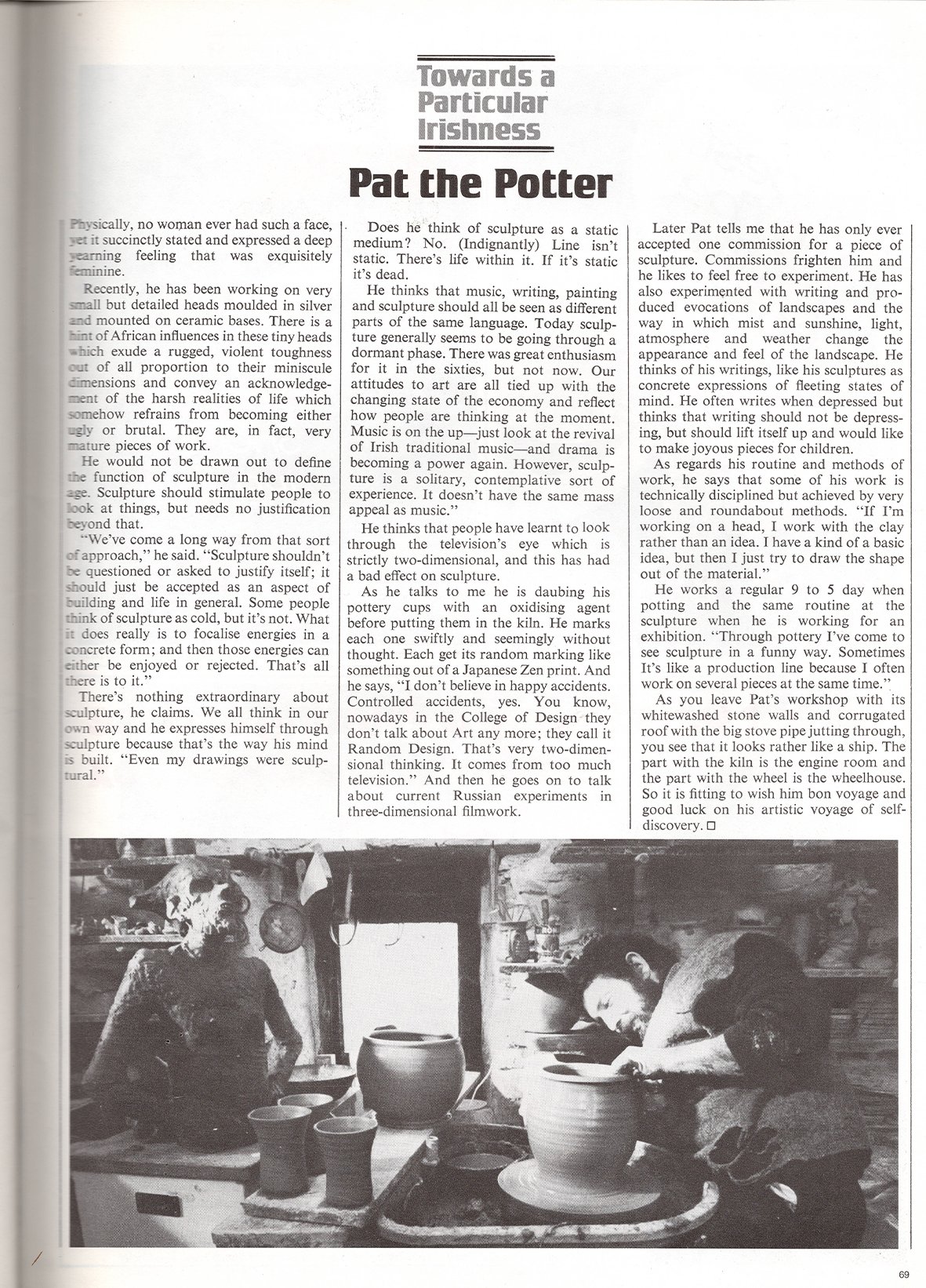
It is a great sight to see Pat at his wheel, looking like a man astride a wooden motorbike with a gramophone turntable where the handlebars should be. He wets and works the soft and spinning piece of dough-like clay, and in a matter of seconds, a cup or a vase or a bowl miraculously appears before him to be cut off from its base with a wire cheesecutter. On a bench nearby sits the inert and sludgy mass of raw clay, and on the shelves around him sit row upon row of the finished products, so solid looking behind their gleaming glaze that is hard to imagine that they too were created from this same mudlike matter.
To the outsider this looks like the central process of the whole business, but Pat says that after a time one comes to see it just as the initial stage. The adding of handles and refinements, finishing and firing—all this is what takes up most of the worker's time.
Most of the time Pat works on his own and admits that sometimes he finds it a lonely way of life. He would like to have other people working with him in the same workshop but feels that he would have to reorganise his workshop if this were to be possible as at the moment there is barely enough space for him to work in it alone.
However, from time to time he has had other people come to work with him to learn something of his craft and to gain some first hand experience. He remembers one girl who was a dancer and when she got involved with throwing clay on the wheel took to it immediately and delighted in the sensuous experience of working the hands in the soft wet clay. When you've been at it for years, this primitive delight in handling the material can easily be lost and forgotten, but sometimes it returns.
Potting is a very personal kind of work. It satisfies a need for expression and the character of one's work reflects one's personality and passing moods. If he spends a day in the workshop when he is fed up and depressed, then the articles he makes that day are definitely inferior; in his own graphic phrase, they are "dead pots". But, of course, just the opposite is true on a day when he feels in good form. According to Michael Cardew it takes seven years to become a potter. Pat reckons that he has just about made it; but only just.
I asked him to tell me something about his sculptures, and, characteristically, after saying, "I can't talk about the sculpture", went on to discuss them at length.
Pottery and sculpture are closely related forms and the techniques of one interact with those of the other. Some of his work is an amalgam of the two techniques. He will throw a basic shape on the wheel, and then work it over by hand just as if he were making a jug. He showed me a mask of a face he had made in this way. It had a kind of Japanese flavour about it—like something out of a Noh play.
In fact, most of his work in sculpture takes the form of busts, masks and models of the human head. He believes that people are important and does not see the main task of the sculptor as that of experimenting with free forms, shapes and curves. He does not like to call such work "abstract" as to his mind all art is abstract. But on the other hand his own work could hardly be termed representationally realistic. If anything, it tends in an expressionistic direction.
He showed me the bust of a woman's head that certainly fitted this description. The whole work was executed in a sweep-ing, questioning, ripe and rounded curve. Physically, no woman ever had such a face, yet it succinctly stated and expressed a deep yearning feeling that was exquisitely feminine.
p67
Recently, he has been working on very small but detailed heads moulded in silver and mounted on ceramic bases. There is a hint of African influences in these tiny heads which exude a rugged, violent toughness out of all proportion to their miniscule dimensions and convey an acknowledgement of the harsh realities of life which somehow refrains from becoming either ugly or brutal. They are, in fact, very mature pieces of work.
He would not be drawn out to define the function of sculpture in the modern age. Sculpture should stimulate people to look at things, but needs no justification beyond that.
"We've come a long way from that sort of approach," he said. "Sculpture shouldn't be questioned or asked to justify itself; it should just be accepted as an aspect of building and life in general. Some people think of sculpture as cold, but it's not. What it does really is to focalise concrete form; and then those energies can either be enjoyed or rejected. That's all there is to it.”
There’s nothing extraordinary about sculpture, he claims. We all think in our own way and he expresses himself through sculpture because that's the way his mind is built. "Even my drawings were sculptural”
Does he think of sculpture as a static medium? No. (Indignantly) Line isn’t static. There's life within it. If it's static it’s dead.
He thinks that music, writing, painting and sculpture should all be seen as different parts of the same language. Today sculpture generally seems to be going through a dormant phase. There was great enthusiasm for it in the sixties, but not now. Our attitudes to art are all tied up with the changing state of the economy and reflect how people are thinking at the moment. Music is on the up—just look at the revival of Irish traditional music-and drama is becoming a power again. However, sculpture is a solitary, contemplative sort of experience. It doesn't have the same mass appeal as music.”
He thinks that people have learnt to look television's eye strictly two-dimensional, and this has had a bad effect on sculpture.
As he talks to me he is daubing his cups with an oxidising agent before putting them in the kiln. He marks each one swiftly and seemingly without thought. Each get its random marking like something out of a Japanese Zen print. And he says, "I don't believe in happy accidents. Controlled accidents, yes. You know nowadays in the College of Design they don't talk about Art any more; they call it Random Design. That's very two-dimen-sional thinking. It comes from too much television." And then he goes on to talk about current Russian experiments in three-dimensional filmwork.
Later Pat tells me that he has only ever accepted one commission for a piece of sculpture. Commissions frighten him and he likes to feel free to experiment.
He has also experimented with writing and produced evocations of landscapes and the way in which mist and sunshine, light and atmosphere and weather change the appearance and feel of the landscape. He thinks of his writings, like his sculptures as concrete expressions of fleeting states of mind. He often writes when depressed but thinks that writing should not be depress-ing, but should lift itself up and would like to make joyous pieces for children.
As regards his routine and methods of work, he says that some of his work is technically disciplined but achieved by very loose and roundabout methods. “If I’m working on a head, I work with the clay rather than an idea. I have a kind of a basic idea, but then I just try to draw the shape out of the material.”
He works a regular 9 to 5 day when potting and the same routine at the sculpture when he is working for an exhibition. "Through pottery I've come to see sculpture in a funny way. Sometimes It's like a production line because I often work on several pieces at the same time.”
As you leave Pat's workshop with its whitewashed stone walls and corrugated roof with the big stove pipe jutting through, you see that it looks rather like a ship. The part with the kiln is the engine room and the part with the wheel is the wheelhouse. So it is fitting to wish him bon voyage and good luck on his artistic voyage of self-discovery.
p69
What a treat it was to read this article which has been hidden away in a filing cabinet for far too long.
David was an extraordinary, inciteful, kind man and remains a dear friend missed.